
Investing in India: Your Simple Step-by-Step Guide
Start investing in India confidently with this simple step-by-step guide for beginners and smart savers alike.
Investment Guide8 min read
© 2025 Trend Reversal

If you've ever asked yourself, "Where should I invest my money?" — you're not alone. But the real question smart investors ask is:
"How do I build a portfolio that works for me—even when the market doesn't?"
The answer? A rock-solid strategy that blends asset allocation with diversification.
Let's break it down.
Asset allocation is the strategic distribution of your investment across different classes—equities, debt, gold (or real estate/cash). It defines risk and return potential, balancing growth with protection.
Key fact: Between 2016–2025, Indian equities (Nifty 500 TRI) delivered an average annual return of ~14.8%, gold ~14.7%, and debt instruments ~7.4%. A combined 50:25:25 portfolio returned ~13.6% annually but with significantly lower volatility than pure equity investments
Such allocations are shaped by age, risk tolerance, horizon, and goals.
Diversification means spreading your investments across asset classes, sectors, and geographies, thereby reducing the impact of any single underperformer.
Real‑life proof: In FY 2024‑25, gold surged ~33% in rupee terms, outperforming equities that delivered modest 8–9% returns (BSE Sensex up 8.9%, Nifty 50 around 9%).
Meanwhile, multi-asset allocation funds (MAAFs)—with minimum 10% each in equity, debt, and gold—delivered ~17% compounded annual returns over the past 3 years, outperforming Sensex over 3‑ and 5-year spans, while absorbing volatility better.
Media perspective: Recent reports note Indian retail and NRI investors increasingly favor equity for long-term gain, but they often combine it with debt/gold to manage risk amid macro uncertainty.
This framework builds your portfolio in two parts:
Recent trends support this: mid-cap stocks are highlighted as wealth creators, with potential for 28× growth over two decades and attractive risk‑adjusted returns in 2025
Gold has historically offered a hedge during turbulence. In 2025's volatile macro climate—with equity valuations high and debt yields capped—gold has become a strategic allocation, not just cultural tradition.
Further reading: Analysis shows allocating 7.5%–15% to gold improves long‑term risk-adjusted returns and limits drawdowns in Indian rupee portfolios. In the 2024–25 fiscal, gold outperformed equities and debt, delivering ~33% CAGR, while equities lagged around 8–9%.
Historical comparison: Over 11 years till 2025, precious metals topped returns in 6 of them, including 2025 and 2022. That said, equities dominate many years; a balanced mix helps smooth the ride and capture long-term growth.
Even the best allocation can drift over time due to market moves. Equity gains may overweight your original mix—for example, shifting a 70/30 equity/debt portfolio into 80% equity—raising risk inadvertently.
Rebalancing = selling the overweight asset (equity), buying the underweight (debt or gold) to restore initial allocation. Do this once or twice a year, or if allocation drifts > 5–10% from your target.
This disciplined practice preserves your risk profile long-term and enforces smart selling high and buying low.
Meet Sneha and Vikram:
She rebalances annually and enjoys ~13% returns with moderated risk.
He rebalances semi‑annually and targets ~9–10% returns with lower drawdowns.
Building wealth is not about finding the "next big thing."
It's about having a clear strategy that works through every market cycle.
If you're serious about building wealth in India—
Let Trend Reversal guide your journey from investing confusion to financial clarity.
Disclaimer: This content is for educational purposes only and should not be construed as investment advice.
Published by Trend Reversal Team
Start investing in India confidently with this simple step-by-step guide for beginners and smart savers alike.
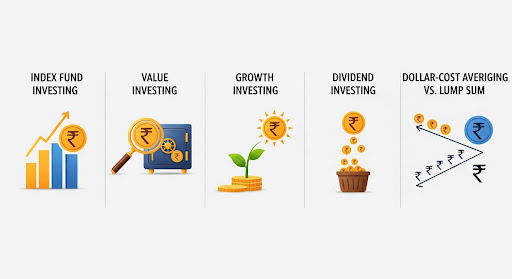
Discover 5 proven investment strategies in India—from index funds to dividends—perfect for all experience levels.

Discover how to invest smartly in India. Learn the difference between saving, investing, and compounding with real examples and latest 2025 insights.